TO the faculty at:
Princeton UNIVERSITY
Thank you so much for spending the time to evaluate my materials and music for the Ph.D in Composition degree. Below are three works with scores and recordings (with listed excerpts) that I feel are not only have strong projects and recordings, but also show important collaborative experiences, current creative interests, and my practice in multimedia and interdisciplinary work. The core portfolio has about 15 minutes of excerpted music split amongst all 3 pieces and are listed in the order I think you should listen in. In addition, I have added two supplemental works that demonstrate other technical skills. Alongside all of these materials, on this page you will also find my curriculum vitae, personal statement, statement of purpose, writing sample, and my (optional but preferred) artistic statement. I hope you all enjoy my music and writings and I appreciate your consideration.
written materials
portfolio
Live performance by Noah Stoker at the University of Michigan in March 2025. Recorded by Nelson Walker.
SHOUTING SOMETHING VULGAR (2024)
FOR SOLO ALTO SAXOPHONE
Excerpt: 0:00-5:07 (mm. 1-119)
Written for Noah Stoker. First performance by Noah Stoker at the University of Memphis in Memphis, TN on October 31, 2024.
Duration: ca. 7.5 minutes
PROGRAM NOTE
It has been several years since I've first discovered the powerful work of late African-American artist, Jean-Michel Basquiat. The most striking part of his artwork, even beyond its reputation of vivid and jarring material and execution, is that it feels what I can only describe as "truthful". The depicted figures are grotesque, his line work is almost sloppy as if a child drew them, and they are, in themselves, cryptic and curious. Yet, it almost feels as if we have the opportunity to view the world from Basquiat's eyes -- his personal truth which he refuses to shy away from. He encourages us to enter his own world, not afraid of what others will think of his odd stylistic decisions and embracing his vision. It inspired the conception of this work, SHOUTING SOMETHING VULGAR, and its underlying content, energy, and style and I express my gratitude to Basquiat's artwork for nding me the confidence to speak about how I feel about the current state of the world, my life, and the people around me.
GOALS AND NOTES ON THIS WORK
An ambitious work for myself, SHOUTING SOMETHING VULGAR was initially a tool to practice several new skills. In particular - control. Before this work, I felt very frustrated with the number of amazing ideas that emerged during workshops and post-premiere. As I finished the final draft, I wanted this composition to be complete with my own ideas, primarily. Although I accepted that ideas will naturally evolve as a piece is heard and workshopped, I had a desire to be as thorough as possible in its initial stage. This felt well-achieved as I immediately recognized the work as one of, if not, my best, and there were only a tiny amount of edits that were created after the premiere.
My music can tend to have lots of energy, but in previous pieces I felt out of control of this energy. Many of my works were spatially and graphically notated, but I wanted to test my specificity and detail in creating this piece. There were two works that greatly inspired this piece’s sound worlds. The first is the subdued fidgeting found in Marcos Balter’s Wicker Park. Next next is the erratic and stressful soloist material in Mangle of Practice by George Lewis. Reading the scores of these works inspired me to take ownership of every tiny detail in this piece, including every minute dynamic and rhythmic fluctuation.
Up until several months before writing this piece, I struggled to find an interest in microtonal music. None of the pieces I had been exposed to used them in a way that I could relate to, until I discovered works by Viet Cuong (Electric Aroma) and Elijah Daniel Smith (Stagnation Blues and The Violence of Air). These works introduced the idea to me of using the quarter tones as an extension of the chromatic scale, keeping a similar harmony while dipping in and out of a distorted texture. Although this textural effect could not be done to the same effect using only a solo instrument, I still utilized the saxophone’s virtuosity and flexibility to create interesting effects within itself. In this piece, the microtones also mock a chromatic scale (first seen in measures 31-33, compressing the prominent “B-flat - A - G-sharp” motive into quarter step variations, after being prepared by a glissando in the previous measure. Noah and I spent a significant amount of time to find which notes to build the piece around due to how well the saxophone functions with the techniques I wanted to include.
Recorded by Hypercube Ensemble (Erin Rogers, saxophone; Jay Sorce, guitar; Chris Graham, percussion; Andrea Lodge, accordion) at Adelphi University in Garden City, NY.
LIKE A DREAM SLOWLY FORGOTTEN (2025)
FOR ALTO SAXOPHONE, electric guitar, percussion, accordion and electronics
EXCERPT: MVT. I, 0:00-5:04 (MM. 1-78)
This piece was written for Hypercube. First performance by Hypercube virtually as part of their CubeLab series in November 2025.
MOVEMENTS
I. Twenty-four attempts at recalling a dream
II. Gibbersong
III. I want to remember this
PROGRAM NOTE
One of the strangest aspects of dreams in the attempted process of recollection after you wake up. It always feels as if the more you try to think about the dream or piece ideas together, the entire concept slips away from you altogether. In LIKE A DREAM SLOWLY FORGOTTEN, the title also serves as a sort of performance note. Over three attaca movements, a simple melody is briefly introduced once and is slowly taken apart, passed around, and eventually lost in the music. Quickly, it only reappearing in brief, poorly replicated instances. The three movements of this work embody three different states of being I have found myself after waking up, each approaching the idea of blur in a multitude of ways as the piece slowly switches the roles of the instrumentalist and electronics as foreground and background voices.
The first titled ‘Twenty-four attempts at recalling a dream’ takes the initial ‘dream motive’ (B-flat, A-flat, G, D (F)) and introduces it quickly once in the saxophone, then it becomes quickly developed within throughout the ensemble in a meditative state. Re-introduced twenty-three more times throughout this movement. It never occurs the same twice and is regularly fragmented or incomplete, but it’s presence is always felt on every return.
In the second, ‘Gibbersong’, the electronics begin their push into the foreground. A mash-up of speeches, riots, and general noise is heavily processed and placed under the ensemble. It is accompanied by the fidgeting, yet oddly lyrical saxophone playing above it in a repeated frenzied pattern which mimics the electronics. In the midground, the guitar created a light blanket of sound while the crotales and accordion subtly pluck out the original melody in fragments.
In the final movement, ‘I want to remember this’, I draw inspiration from the feeling of waking up from a dream where everything is perfect to return to reality where everything isn’t. The movement once again features the alto saxophone is a beautiful solo, accompanied by the rest of the quartet playing small, supporting tones. Ultimately, the saxophone and gutiar come together for a powerful chord as the electronics take the foreground by playing the melody in a very subdued way. All voices fade out until one final shaky, unpitched sound quickly ends the work.
Live performance by Sharon Harms, the Conference Ensemble (Barry Crawford, flute; Mike Lombard, trombone; Louise Schulman, viola; Greg Chudzik, bass; Mike Truesdell, percussion; Steven Beck, piano), and Matilda Hofman at the Avaloch Farm Music Institute in Boscawen, NH in August 2025.
THE INTERLOCKING OF HANDS (2025)
FOR SOLO SOPRANO VOICE AND SMALL ENSEMBLE
excerpt(s): mvt. V, 13:14-end (MM. 229-END)
Written for the Fromm Foundation Composers Conference. First performance by soloist Sharon Harms, the Conference Ensemble (Barry Crawford, flute; Mike Lombard, trombone; Louise Schulman, viola; Greg Chudzik, bass; Mike Truesdell, percussion; Steven Beck, piano), and conductor Matilda Hofman at the Avaloch Farm Music Institute in Boscawen, NH in August 2025.
Scored for Fl. Trb. Vla. Cb. Perc*. Pno
*Percussion List: Crotales, Vibraphone, Two Wood Blocks, Two Suspended Cymbals, Sandpaper Blocks (or something of a similar texture), Tom Drum, Bass Drum, Tam-Tam
TEXT
The park is filled with night and fog,
The veils are drawn about the world,
The drowsy lights along the paths
Are dim and pearled.
Gold and gleaming the empty streets,
Gold and gleaming the misty lake,
The mirrored lights light sunken swords,
Glimmer and shake.
Oh, is it not enough to be
Here with this beauty over me?
My throat should ache with praise, and I
Should kneel in joy beneath the sky.
Oh, beauty, are you not enough?
Why am I crying after love
With youth, a singing voice and eyes
To take earth’s wonder with surprise?
Why have I put off my pride,
Why am I unsatisfied,
I for whom the pensive night
Binds her cloudy hair with light,
I for whom all beauty burns
Like incense in a million urns?
Oh, beauty, are you not enough?
Why am I crying after love?
- SPRING NIGHT by Sara Teasdale
GOALS AND NOTES ON THIS WORK
I was completely stunned and honored to be admitted to the Fromm Foundation Composers Conference. Having the chance to write a substantial work for voice and ensemble ,which I knew I wanted to include in my portfolio for so long, was a major deal for me and I was beyond excited to write my first opera-like piece. The musicians that I had the pleasure to work with were some of the most accomplished and talented players I ever had the chance to collaborate with to this day, and I appreciate each of their willingness to workshop my piece over the week. Although I generally enjoying trying something new in every composition, in this work I generally focused more on evolving ideas in my music that I have practiced a lot over the last several years at the University of Michigan. Among these subjects are a want to tighten my grasp on structure in larger works, significant contrast within pieces, and making sure my writing for the voice feels like a perfect blend of operatic singing and conversational speaking. In many ways, this work is the culmination of everything I learned during my time at the University of Michigan.
SUPPLEMENTAL WORKS
SOMETHINGLIKEASILLYLITTLELOVESONG (2025)
FOR fixed media electronics and two dancers
EXCERPT: 3:16-End
Written for PART-Ensemble as part of the 2025 Collaborative Composition Initiative. Premiered by PART-Ensemble dancers Jennie Boultbee and Mateusz Bogdanowicz at Shepherd King Lutheran Church in San Antonio, TX in August 2025.
PROGRAM NOTE
The love of your life is closer than you think.
GOALS AND NOTES ON THIS WORK
As you will be able to tell in each of these explanations on my pieces, one of my main motivations in composing is doing something new in every piece I write. It does not have to be reinventing the wheel. As long as it’s something new to me, I will find a great amount of pleasure in warping a new concept into my own voice into every new piece. This piece, however, was an entirely brand new experience in every way. I never wrote an electronics track before nor worked with dancers before. I was very excited to write
The electronics for this piece were done in Logic using preset sounds that I heavily altered and processed. Through writing this piece, I found a love for the fact that if I don’t like a sound in Logic that I can always change it however I’d like and have complete creative control. The sounds are primarily synthesizers with some preset instruments such as vibraphone, electric guitar, and bass. The track is quite mesmerizing and simple at first, but the addition of the keyboard tones bending downward start to incorporate a hypnotic element to the composition. More than half-way through the track, I decided the sounds have been too floral and wanted to “dirty up” the texture. Here, I add in the delayed vibraphone, where I manually tweak the high end over time to create a fluctuation of mellow and metallic sounds. After a few instances of this, the electric guitar is used to deeply cut through the texture. It’s constant bending up and down adds to the lucid nature of the track, and eventually all voices build into a single impactful movement. Afterwards, the track slowly phases out by mimicking the soft pad at the beginning, but sprinkling in some of the sounds that were used that culminated in the peak of the track. After I finished this core section, I sectioned off the opening pad to the final climax, time compressed it to thirty seconds, then pitched it up a fifth. This is the opening glitch section that you first hear in the track and the pitch-up creates a V-I progression for the pad once it enters.
I don’t think I could have been more fortunate to work with anyone else other than Jennie and Mateusz for my first time working collaborating with dancers. They were incredibly professional and skilled communicators. The two work together in a dance company in Germany in addition to their work with PART-Ensemble, and therefore were already on the same page about comfortability with one another. In our workshops, the music influenced the dance, and the dance influenced the music. Going into the collaboration, I simply knew I wanted slow, flowing movements, they should start on opposite ends of the hall and move to the center, and should be dancing around one another. As they continued to improvise, I was stunned by the way they would move so close to one another, in each others space, yet not touching one another. This, along with avoiding eye contact, become important parts of the dance, as subtle as they are. In the end, the instructions for the dancers correlate to notable instrumentation additions in the track. All of the work we did together formed into the very simple program note “The love of your life is closer than you think." It refers to the fact you can be friends with someone for so long, have amazing chemistry with them, but not realize you have a romantic interest with them. The interlocked dancing represents this chemistry which the lack of eye contact signifies not realizing they are meant for you. This lack of eye contact is maintained until the very end where the dancers stare into one another’s eyes as the track fades out.
Live performance by Jennie Boultbee and Mateusz Bogdanowicz in San Antonio, TX in August 2025. Recorded by Yeonsuk Jung and Mary Denney.
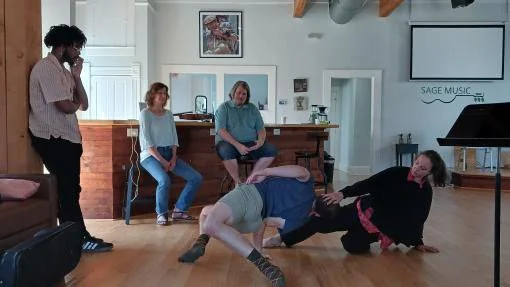
Picture of me with dancers Jennie and Mateusz as we workshop new movements and pacing for the track.
Live performance by University of Michigan Philharmonia Orchestra conducted by Kendra Chao at Hill Auditorium at the University of Michigan in Ann Arbor, MI in February 2025.
FRAGRANCES OF SOMETHING SWEET (2024-25)
FOR ORCHESTRA
EXCERPT: 3:47-END (MM.72-96)
Written for the University of Michigan Philharmonia Orchestra as my master’s thesis, advised by Bright Sheng. First performance by the University of Michigan Philharmonia Orchestra conducted by Kendra Chao at Hill Auditorium at the University of Michigan in Ann Arbor, MI in February 2025.
Scored for 2.2.2.2/4.3.3.1/2perc*/pno/hp/str
*Percussion List: Crotales, Vibraphone, Suspended Cymbal, 4 Triangles (all different sizes, if able)
PROGRAM NOTE
I wrote this piece with a particular memory I had with my grandmother Mary, who I had been thinking about a lot over the nine months I wrote this piece. She was the first person who introduce me to coffee, which I love a lot now. After always being refused the drink by my mom, I remember jump at the opportunity to have it, which, oddly, resulted in me completed knocked out on her living room floor. In every cup of coffee I have to this day, I think about her. The title "something sweet" refers to coffee, this piece is about, but in particular to my grandmother who was also someone incredibly sweet, kind, and supportive.
GOALS AND NOTES ON THIS WORK
Writing this piece made me come to terms with something I almost felt I was not allowed to say — I don’t like writing for the orchestra and I, for the most part, don’t like orchestra music. When I began writing this piece, I searched through my saved pieces on my phone to gain inspiration. It was only then I realized that I only had about three orchestral pieces saved and the bulk of classical music I listened to was intimate and soft chamber music. Generally, I am not a fan of over-the-top and bombastic music — and that’s okay. The large ensemble pieces I did enjoy were primarily solo concertos (Corigliano Clarinet Concerto, for example) or concertos for orchestra (such as the ones by Bartok and Zhou Tian). Instead of forcing myself to write music I don’t like, instead I decided to treat the orchestra as a large chamber ensemble. The bulk of this piece is finding out ways to make an 80-100 person ensemble feel like a group of 4 or 5 players. Most of the piece is orchestrated thinly with many solo lines. Most instruments weave in and out for a single measure or gesture at a time. In the initial stages of this work, when I shared the first draft with many of my colleagues and mentors such as Bobby Ge, Nick Bentz, and Roger Zare, I received encouragement of my desire to keep the sound intimate, but was reminded by each of them “this is still an orchestra”. I found moments within this piece for larger moments of sound to keep the identity of the ensemble in tact in ways that did not feel forced to me. By the end of the eight months it took me to write this piece, I felt a newfound appreciation for writing for orchestra that I did not have before. I still do not have any goals to become a full-time orchestral composer, I look forward for the next chance to write another orchestra piece that upholds my vision of a personable and sparingly stark sound.
You have reached the end of my portfolio! I hope my work has been of interest to you and I sincerely thank you again for taking your time reviewing my works. Please feel free to reach out if you have any questions or concerns about materials or if any links appear to be broken.
All the best,
Ty Bloomfield
Part-Time Lecturer in Music Theory, Eastern Michigan University
Music Creativity Instructor, Ypsilanti Youth Orchestra
(734) 678-0108
bloomfieldty25@gmail.com (personal)/ tylerbloomfieldmusic@gmail.com (professional)